


HAU: Journal of Ethnographic Theory, is an international peer-reviewed, partly open-access journal that appears in both digital and print format. It aims to take ethnography as the prime heuristic of anthropology, and return it to the forefront of conceptual developments in the discipline.
The journal is motivated by the desire to reinstate ethnographic theorization in contemporary anthropology as an alternative to explanation or contextualization by philosophical arguments--moves which have resulted in a loss of the discipline's distinctive theoretical nerve. By drawing out anthropology’s potential to critically engage and challenge its own cosmological assumptions and concepts, HAU aims to provide an exciting new arena for evaluating ethnography as a daring enterprise for worlding alien terms and forms of life, exploring their potential for rethinking humanity, self, and alterity.
HAU takes its name from a Māori concept, whose controversial translations—and the equivocations to which they gave rise—have generated productive theoretical work in anthropology, reminding us that our discipline exists in tension with the incomparable and the untranslatable. Through their reversibility, such inferential misunderstandings invite us to explore how encounters with alterity can render intelligible a range of diverse knowledge practices. In its online version, HAU stresses immediacy of publication, allowing for the timely publication and distribution of untimely ideas. The journal aims to attract the most daring thinkers in the discipline, regardless of position or background.
HAU welcomes submissions that strengthen ethnographic engagement with received knowledges, revive the vibrant themes of anthropology through debate and engagement with other disciplines, and explore domains held until recently to be the province of economics, philosophy, and the sciences. Topics addressed by the journal include, among others, diverse ontologies and epistemologies, forms of human engagement and relationality, cosmology and myth, magic, witchcraft and sorcery, truth and falsehood, science and anti-science, art and aesthetics, theories of kinship and relatedness with humans and non-humans, power, hierarchy, materiality, perception, environment and space, time and temporality, personhood and subjectivity, and the metaphysics of morality and ethics.
Free access journal
The University of Chicago Press publishes one free-access journal: HAU: Journal of Ethnographic Theory. This model provides one month of free access after the release of each new issue, and then requires a subscription for continuous access to content. All HAU: Journal of Ethnographic Theory content published from 2011-2017 is open access.
Announcements
In memoriam Keith Hart |
|
John Keith Hart, the iconoclastic anthropologist who coined the term "informal economy" and reimagined money as a form of memory, died in Paris on November 6th. He was 82. Hart’s life was one of constant intellectual migration, traversing what he called an ongoing "world revolution." Born in Old Trafford, Manchester, in 1943, Keith often spoke of his upbringing as a transition from the "run-down" streets of a war-torn city to the elite halls of Cambridge studying Classics in their original languages. He eventually "defected" to anthropology under the supervision of Jack Goody. While he had a combative yet respectful relationship with the department’s "powerhouse," Meyer Fortes, he found his true intellectual anchor in the guidance of Audrey Richards at the African Studies Centre, who pointed him toward the groundbreaking study of urbanization. Keith’s intellectual restlessness propelled his overflowing corpus of work, but he is perhaps best characterized by his revolutionary approach to money and the digital future. In The Memory Bank: Money in an Unequal World (2000), he foresaw the current digital era as a return to the "pluralism" of money, arguing for new possibilities for democratic exchange. This theme was explored in The Hit Man's Dilemma: Or Business, Personal and Impersonal (2005). Published by Prickly Paradigm Press—which he co-founded with Marshall Sahlins to revive the Victorian tradition of the radical, polemical pamphlet—the book reflected on a world of "impersonal" institutions (corporations, states, markets) that demand we suppress our humanity and values. Hart often felt this tension personally, describing himself as a "hired gun" moving between Manchester, Yale, Chicago, and Cambridge, critiquing the university as a "bureaucratic machine" while practicing an intensely personal, chaotic, and relational style of scholarship. He was a cherished figure in the HAU community, with contributitions such as "Money from a cultural point of view," where he dismantled utilitarian views, arguing instead that money is "culturally plastic," a symbolic system that humans can reinvent. Likewise, in "On gambling, divination, and religion," he elevated his lifelong practice as a "betting man" (who famously funded his education through horses) into a philosophical method. He argued that the gambler, much like the diviner, uses ritual to negotiate and engage with society's great unknowns. His passion for building new intellectual space resulted in tireless collaboration. With Chris Hann, he co-authored the state-of-the-art textbook Economic Anthropology (2011) and co-edited Market and Society (2009). Furthermore, his leadership of the Human Economy Programme at the University of Pretoria produced a series of vital collections that rallied a new generation of scholars to his cause, including Money in a Human Economy (2017). In his final years, Keith turned toward intimate syntheses. His memoir, Self in the World: Connecting Life's Extremes (2022), was not merely an autobiography but a demonstration of a method that uses the specificities of a life to illuminate global society. He remained intellectually vigorous to the end, leaving behind a final manuscript on Marcel Mauss, whose work on the social form of "the gift" and "the person" deeply informed Hart's vision. It is a work we hope can be published soon. Keith Hart leaves behind a discipline he fundamentally shook up, a strong network of colleagues in the Open Anthropology Cooperative—which also served as a fomenting ground out of which HAU grew—and a body of work that is smart and funny. As he reflected in one of his final Substack posts earlier this year, this spirit was achieved and animated by an eclectic mix of passions: "music, maths, money and movies." |
|
| Posted: 2025-12-13 | |
| More Announcements... |
Vol 16, No 2 (2026)
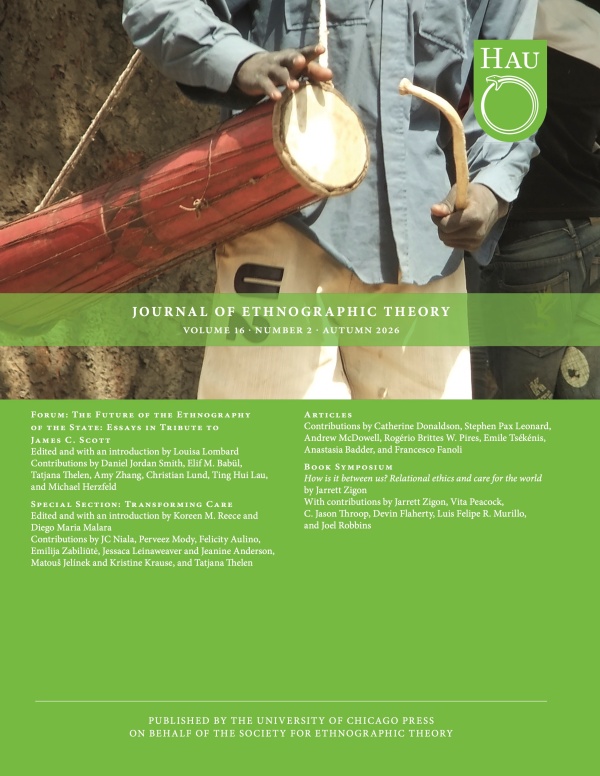
Table of Contents
Editorial Note
|
Playing with concepts
Adeline Masquelier, Louisa Lombard, Michael Herzfeld, Tiago Guidi
|
323–326
|
Forum: The Future of the Ethnography of the State: Essays in Tribute to James C. Scott
|
Introduction: Marveling over the state
Louisa Lombard
|
327–330
|
|
How Nigerians see the state: An essay in honor of James C. Scott
Daniel Jordan Smith
|
331–336
|
|
Rethinking Scott in an era of post-developmental restorationist state formation
Elif M. Babül
|
337–342
|
|
After Scott: Perspectives for the future of the ethnography of the state
Tatjana Thelen
|
343–348
|
|
The high-modernist state: Rethinking environmental authoritarianism in the twenty-first century
Amy Zhang
|
349–354
|
|
Weapons of the wronged: Notes on law’s double-edge
Christian Lund
|
355–362
|
|
Seeing like a surveillance state: Settler colonialism on the China–Myanmar border
Ting Hui Lau
|
363–370
|
|
A plethora of polities: The state, the nation-state, and the ethnonational state
Michael Herzfeld
|
371–375
|
Special Section: Transforming Care
|
Transforming care
Koreen M. Reece, Diego Maria Malara
|
376–385
|
|
JC Niala
|
386–401
|
|
Perveez Mody
|
402–414
|
|
Felicity Aulino
|
415–429
|
|
Emilija Zabiliūtė
|
430–443
|
|
Jessaca Leinaweaver, Jeanine Anderson
|
444–456
|
|
Matouš Jelínek, Kristine Krause
|
457–471
|
|
Tatjana Thelen
|
472–474
|
Articles
|
Catherine Donaldson
|
475–490
|
|
Stephen Pax Leonard
|
491–504
|
|
Andrew McDowell
|
505–518
|
|
Rogério Brittes W. Pires
|
519–535
|
|
Emile Tsékénis
|
536–553
|
|
Anastasia Badder
|
554–568
|
|
Francesco Fanoli
|
569–583
|
Book Symposium
|
Introduction
Jarrett Zigon
|
584–586
|
|
Radical hospitality in a Berlin hackerspace
Vita Peacock
|
587–592
|
|
Los Angeles is burning …
C. Jason Throop
|
593–597
|
|
Terminal prognosis as information-fact: Considering health data from a Zigonian perspective
Devin Flaherty
|
598–603
|
|
“What is it between us?” Relational ethics for the study of Human–AI interaction
Luis Felipe R. Murillo
|
604–610
|
|
What is there between us?: Reflections on Zigon’s relational ethics
Joel Robbins
|
611–615
|