


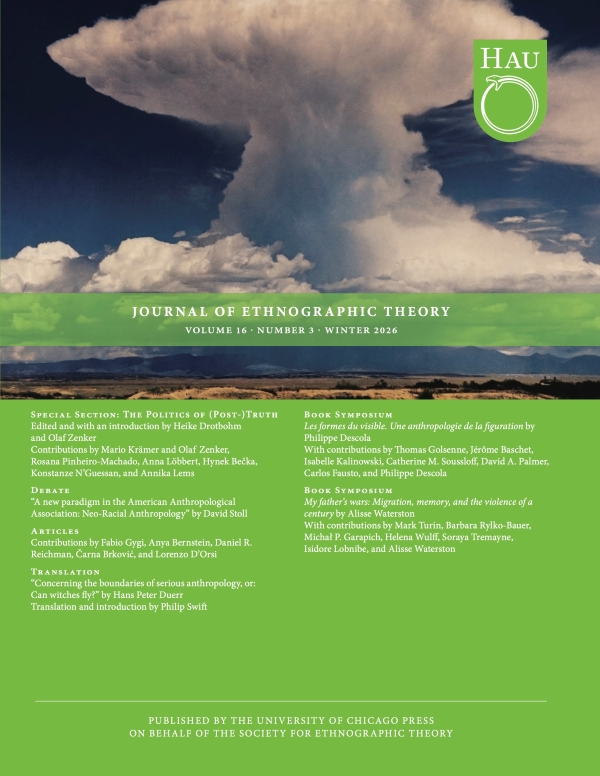
Table of Contents
Editorial
|
Thunderstorms
Louisa Lombard
|
617–621
|
Special Section: The Politics of (Post-)Truth
|
Heike Drotbohm, Olaf Zenker
|
622–631
|
|
Mario Krämer, Olaf Zenker
|
632–646
|
|
Rosana Pinheiro-Machado
|
647–662
|
|
Anna Löbbert
|
663–678
|
|
Hynek Bečka
|
679–692
|
|
Konstanze N’Guessan
|
693–707
|
|
Annika Lems
|
708–722
|
Debate
|
David Stoll
|
723–737
|
Articles
|
Fabio Gygi
|
738–753
|
|
Anya Bernstein
|
754–768
|
|
Daniel R. Reichman
|
769–783
|
|
Čarna Brković
|
784–799
|
|
Lorenzo D’Orsi
|
800–815
|
Translation
|
Philip Swift
|
816–836
|
|
Hans Peter Duerr
|
837–845
|
Book Symposium
|
Philippe Descola and art history, past and present
Thomas Golsenne, David Radzinowicz
|
846–852
|
|
The “Descolian square” in the face of figuration
Jérôme Baschet
|
853–859
|
|
Descola’s figures of the invisible
Isabelle Kalinowski
|
860–866
|
|
Figurations of the world: What Descola sees
Catherine M. Soussloff
|
867–876
|
|
Fragmentation and integration: Analogical figurations in Descola’s ontological matrix
David A. Palmer
|
877–882
|
|
Ontologies unbound
Carlos Fausto
|
883–887
|
|
Worlding with images
Philippe Descola
|
888–892
|
|
“Maybe consciousness starts with intuition”: A response to My father’s wars
Mark Turin
|
893–895
|
|
My father’s wars and the relevance of intimate ethnography
Barbara Rylko-Bauer
|
896–900
|
|
Two deaths, and the never ending openness of intimate ethnography
Michał P. Garapich
|
901–905
|
|
Momentous memories: From a daughter’s point of view
Helena Wulff
|
906–909
|
|
The merits and pitfalls of intimate ethnography
Soraya Tremayne
|
910–913
|
|
Navigating delicate and durable memories: A daughter-anthropologist’s intimate ethnography
Isidore Lobnibe
|
914–917
|
|
Intimate ethnography amid the wars of the world
Alisse Waterston
|
918–922
|